
You’ve got solar on the roof. The North Queensland sun is doing what it does best, and during the middle of the day your system can be producing plenty of electricity. So why does the power bill still arrive?
The simple answer is timing. Solar makes power when the sun shines, and we don’t always use it then.
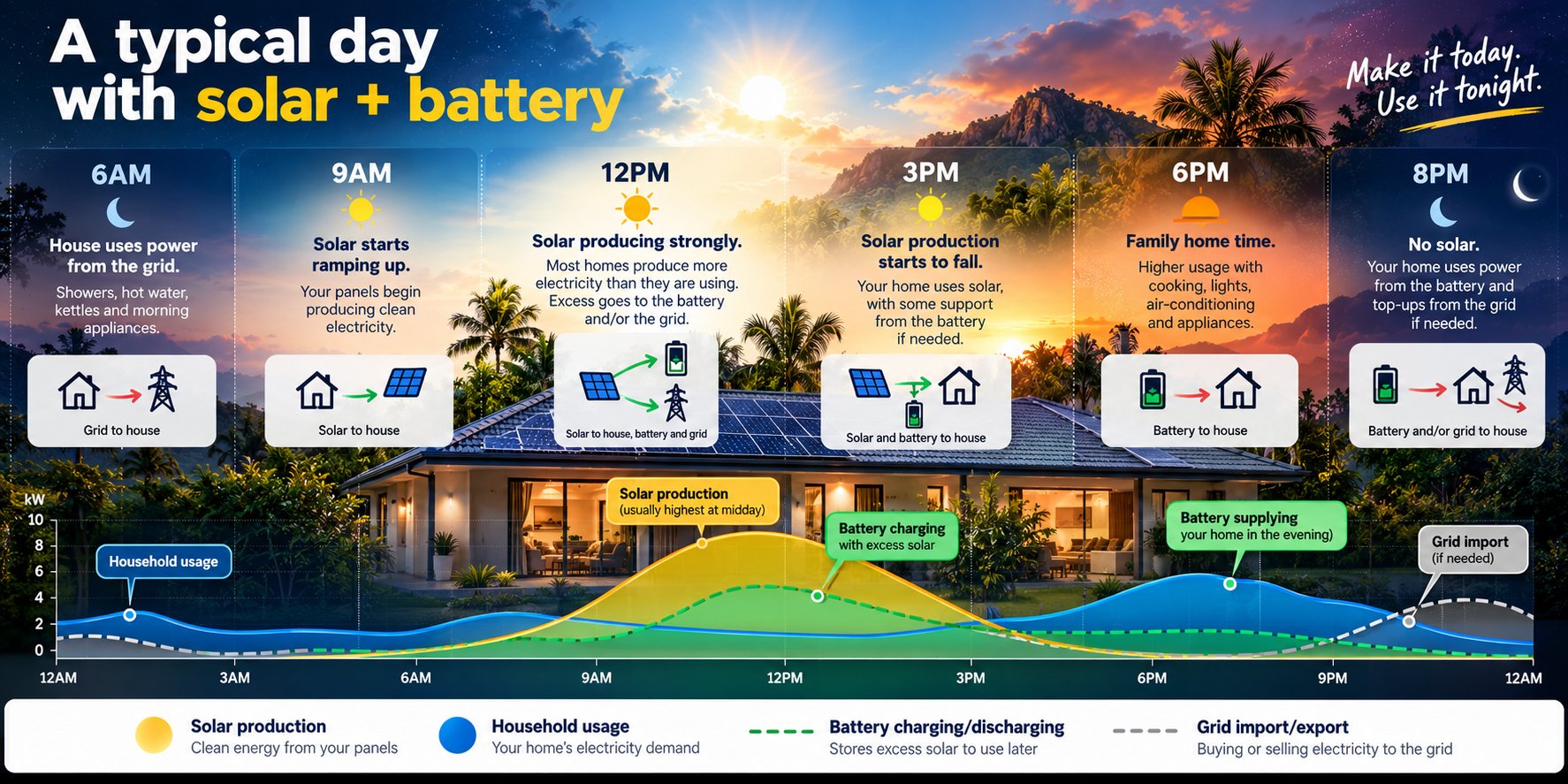
Think about a typical weekday in a Townsville home. At 6am, everyone’s getting ready for work and school. Showers, hot water, kettles, lights and air-conditioners might all be running, but the solar system has barely started producing.
By 9am, solar production is climbing. Around the middle of the day, your panels may be producing considerably more electricity than the house is actually using. Once the home’s immediate needs are covered, that excess solar is generally exported to the grid if there’s nowhere else for it to go.
Then the afternoon rolls around, and solar production starts falling just as everyone comes home. By 6pm, dinner’s cooking, TVs are on, air-conditioners are running and household electricity use can climb again. Except now the sun is disappearing.
By 8pm, your solar panels aren’t producing anything, so without stored energy the home is generally buying electricity from the grid again.
That’s how a house can produce plenty of solar energy during the day and still receive an electricity bill.
The important question isn’t just how much solar you produce
It’s this: how much of your own solar are you actually using?
For many homes, there’s a mismatch between when solar electricity is produced and when the household needs it. You might export excess solar in the middle of the day and then buy electricity from the grid several hours later.
That’s where battery storage changes the equation.
What does a home battery actually do?
Think of a battery as somewhere to put your spare solar.
Without a battery
Solar → House → Excess exported to the grid
With a battery: during the day
Solar → House → Battery
Then later: afternoon and evening
Battery → House
Your panels can charge the battery while the sun is shining, and that stored energy can then help run the house later in the afternoon and evening. You’re essentially shifting your own solar energy from when it’s produced to when you actually need it.
Why that’s particularly interesting in regional Queensland
If you’re on the regulated regional Queensland solar feed-in tariff (paid by Ergon Energy Retail here in Townsville), the rate for 2026–27 is 6.006 cents per kilowatt-hour from 1 July 2026, down from 8.660 cents last year. That makes understanding self-consumption more important than ever.
The question isn’t simply “How much solar can my roof produce?” It’s also “What happens to that electricity after I’ve produced it?”
Exporting electricity isn’t necessarily bad, and the economics are different for every household. But storing more of your excess solar can mean there’s more of your own energy available later, rather than relying as heavily on electricity bought from the grid.
For most Ergon customers on the regional feed-in tariff, adding a battery doesn’t affect eligibility, as long as the network connection is approved first. If you’re still on the old 44c Solar Bonus Scheme, the rules are different, so talk to us before adding a battery.
But bigger batteries aren’t automatically better
This is important. A 40kWh battery isn’t automatically a better investment than a 20kWh battery simply because it’s twice as large.
A properly designed system should consider things like:
- How much electricity the household uses
- When that electricity is being used
- Existing solar system size and typical excess production
- Evening and overnight consumption
- Air-conditioning and other large loads
- Whether blackout backup is important (backup depends on how the system is configured, so not every battery set-up provides it)
- Future plans such as an EV, pool or extra air-conditioning
At Barra Solar Power, we’d rather understand how your home actually uses electricity before deciding how much battery capacity makes sense.
What about the battery rebate?
The Australian Government’s Cheaper Home Batteries Program provides a discount on eligible battery installations, usually passed on by your installer as an upfront reduction in price.
From 1 May 2026, the program changed so that support tapers for larger batteries: the full rate applies to the first 14kWh of usable capacity, then 60% up to 28kWh and 15% up to 50kWh. The STC factor that sets the size of the discount is also scheduled to drop again from 1 January 2027.
That’s another reason we believe battery sizing and system design matter more than simply buying the biggest battery available.
The takeaway
Solar was the first big step: make your own electricity. Battery storage adds the next piece: keep more of that electricity so you can use it later.
For North Queensland households, that can mean getting more value from the solar system that’s already on the roof, and relying less on the grid when solar isn’t producing.
Before choosing a battery, understand when your house actually uses electricity. That’s where we’d start.
Want to know how a battery would work with your solar? Call us on 07 4401 5122 or get in touch through our contact page. We’ll look at how your home uses power before recommending anything.
Barra Solar Power: Trusted Locals since 2014.
Townsville & North Queensland.